
By Josh Tagg ·
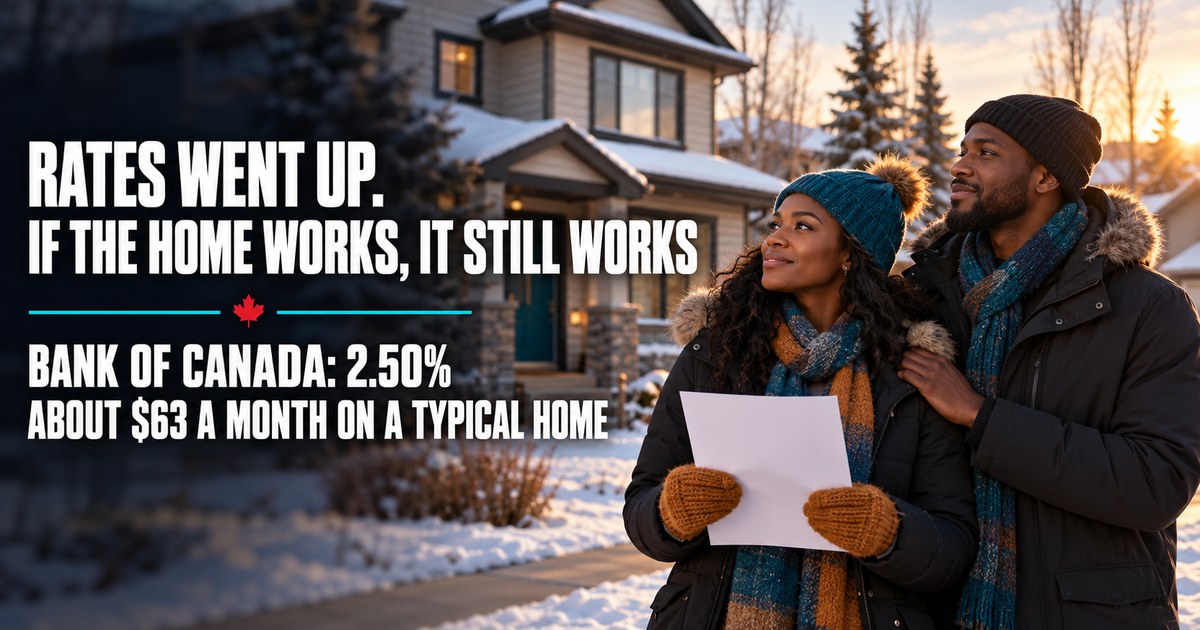
Quick answer: On October 28, 2026 the Bank of Canada raised its policy rate by 0.25 points to 2.50%, its first increase since July 2023. Prime at the big banks goes from 4.45% to 4.70% on October 29. On a $460,500 variable mortgage, about what an average-priced Edmonton home carries with 5% down, that’s about $63 a month more. Fixed rates follow bond yields, not the Bank, and they had already gone up this year.
Jay and I talked through it the morning it happened. His read for buyers: “A quarter point doesn’t change the home.” And: “If the home works, the home still works.” Here’s what changed for Edmonton buyers and owners, and what didn’t.
Why did the Bank of Canada raise rates?
Inflation. The Bank said the conflict in the Middle East, now in its eighth month, is keeping energy prices high for longer. Inflation has been around 3% since April and the Bank expects about 3½% by the end of the year. Without gasoline it was 2.2% in September. The Bank raised rates to stop high energy costs spreading into the price of everything else (Bank of Canada, October 28, 2026).
It said “there could be a need to increase the policy rate further,” and that it will proceed carefully. The next decision is December 9.
What happens to my variable payment?
Prime rises 0.25 points from October 29 (RBC, TD), and a variable rate tied to prime rises with it.
- Adjustable payment: your payment goes up, usually from your next payment.
- Fixed payment: the payment stays the same, but more of it goes to interest.
Here’s an Edmonton home at September’s average sale price of $466,080 with 5% down. The mortgage is about $460,500 including CMHC’s 4.00% premium, over 25 years, at the best insured variable we track (prime minus 0.75%):
| Rate | Monthly payment | |
|---|---|---|
| Variable before the hike (prime 4.45%) | 3.70% | $2,355 |
| Variable after the hike (prime 4.70%) | 3.95% | $2,418 |
| Variable if the Bank raised twice more | 4.45% | $2,547 |
| Best insured 5-year fixed today | 4.64% | $2,585 |
Variable payments use monthly compounding and fixed uses semi-annual. The “twice more” row is arithmetic, not a forecast.
Did fixed rates go up too?
They had already. Fixed rates are priced off Government of Canada bond yields, and the 5-year yield went from 2.67% on February 27 to 3.57% on October 27 (Bank of Canada). The best insured 5-year fixed we track in Alberta rose from 4.09% in July to 4.64% now, while the Bank held at 2.25%.
So today’s hike narrows the gap. Variable was 0.94 points under fixed yesterday. Now it’s 0.69, still about $167 a month on this example. Which one suits you depends on how much a moving payment would bother you, not just on the gap.
I’m buying. What about my rate hold?
A rate hold protects you from increases until it expires. If you got one before the hike, its rate still applies as long as you buy before the expiry date.
That’s where new builds need care. Holds usually run 120 to 180 days, and a build with a spring or summer possession can run past that. From the builder’s side, possession dates also slip. If your possession is past your hold’s expiry, ask your lender now what rate applies on the day you close, and read your purchase agreement’s financing terms with your lawyer. Our post on what has to happen before you remove your financing condition covers the resale side.
A hike also raises the qualifying rate on a new variable approval, from 5.70% to 5.95%. For a household earning $120,000 with $500 a month for property tax and heat, that’s about $534,000 of mortgage instead of $547,000. On a fixed rate it’s unchanged: 4.64% qualifies at 6.64%, about $501,000.
What’s the Edmonton market doing?
REALTORS® Association of Edmonton’s September numbers, the latest out, had 1,959 sales across the Greater Edmonton Area, down 10.3% from a year earlier. New listings were up 11.3% and inventory was up 16.7%. The average price was $466,080, up 2.9%, and the benchmark price was $423,100, down 0.3% (RAE, October 2, 2026).
More listings and fewer sales mean more choice for a buyer with financing in place. On a $466,000 home, the price you negotiate moves your budget more than this quarter point does.
When this doesn’t apply
If you’re partway through a fixed term, nothing changes until you renew. If your lender sets its own prime, check its notice; the numbers here use the big-bank prime. And if you’re self-employed or counting on overtime to qualify, how a lender reads your income matters far more than a quarter point.
Want us to run your numbers both ways? Book a call and we’ll show you the fixed and variable payment on the home you’re looking at. Our Bank of Canada page has the video Jay and I recorded on the day.
This is commentary, not advice. Rates are the best we tracked from lender rate sheets as of October 28, 2026 and can change daily. The figures in the examples are illustrations. All mortgages are subject to lender and insurer approval.
Frequently asked
Did the Bank of Canada raise rates on October 28, 2026?
Yes. It raised its policy rate by 0.25 points to 2.50%, the first increase since July 2023. The big banks' prime rate rises from 4.45% to 4.70% on October 29.
How much will my variable payment go up in Edmonton?
On a $460,500 insured mortgage, about what an average-priced Edmonton home carries with 5% down, the payment goes up about $63 a month at the best insured variable we track. If your payment is fixed and only the rate floats, the payment stays the same and more of it goes to interest.
Did fixed rates go up because of the hike?
Not directly. Fixed rates follow Government of Canada bond yields, which had already risen this year. The best insured 5-year fixed we track in Alberta was 4.64% on October 28, up from 4.09% in July.
I have a rate hold. Is it still good?
Yes, until it expires. A rate hold protects you from increases, so a hold taken before the hike keeps its rate if you buy before the expiry date. If your possession date is past the expiry, which is common on new builds, talk to your lender before you firm up.
Should I wait to buy until rates come back down?
The Bank said there could be a need to raise rates further, so waiting for a cut is a bet. A quarter point changes the payment, not the home. If the home fits your budget at today's rate with room to spare, the hike doesn't change that.